-
Shop
- Advanced Technologies
- AI Skills
- Apple Accessories
- Arts, Crafts & Hobbies
- Bathroom
- Beauty
- Best-Sellers
- Car Accessories
- Car Buying & Ownership
- Confidence
- Dating & Social Skills
- Digital Resources
- Education & Learning
- Family & Parenting
- Fashion
- Alexander McQueen
- Bags & Wallets
- Balenciaga
- Belts
- Blazers
- Bottega Veneta
- Bottoms
- Brunello Cucinelli
- Burberry
- Chanel
- Chloé
- Dior
- Dolce & Gabbana
- Dresses
- Etro
- Fendi
- Gucci
- Hats & Hair Accessories
- Hoodies & Sweatshirts
- Jacquemus
- Jewelry
- Jil Sander
- Jimmy Choo
- Kiton
- Luggage
- Men's Fashion
- Miu Miu
- Off-White
- Outerwear
- Prada
- Rick Owens
- Saint Laurent
- Scarves
- Shoe Accessories
- Shoes
- Skirts
- Socks & Tights
- Sunglasses
- Sweaters & Cardigans
- The Row
- Tom Ford
- Tops & Shirts
- Valentino
- Valentino Garavani
- Versace
- Vivienne Westwood
- Watches
- Fashion Accessories
- Furniture
- Gadgets
- Gift Ideas
- Gifts
- Health & Beauty
- Health & Wellness
- Home & Garden
- Home & Kitchen
- Home Electronics
- Home Styling & Organization
- Home Supplies
- Kids & Babies
- Kids & Babies
- Kitchen
- Lighting
- Nike
- Parenting & Child Development
- Patio, Lawn & Garden
- Personal Growth
- Personal Style & Fashion
- Pet Care
- Pet Lifestyle & Wellness
- Pet Supplies
- Pets
- Sport & Outdoors
- Super Deals
- Travel
- Travel & Adventure
- Wealth
- Wellness
- Popular
- Best deals
20-Bar Semi-Auto Espresso Machine: Temp Control, 58mm
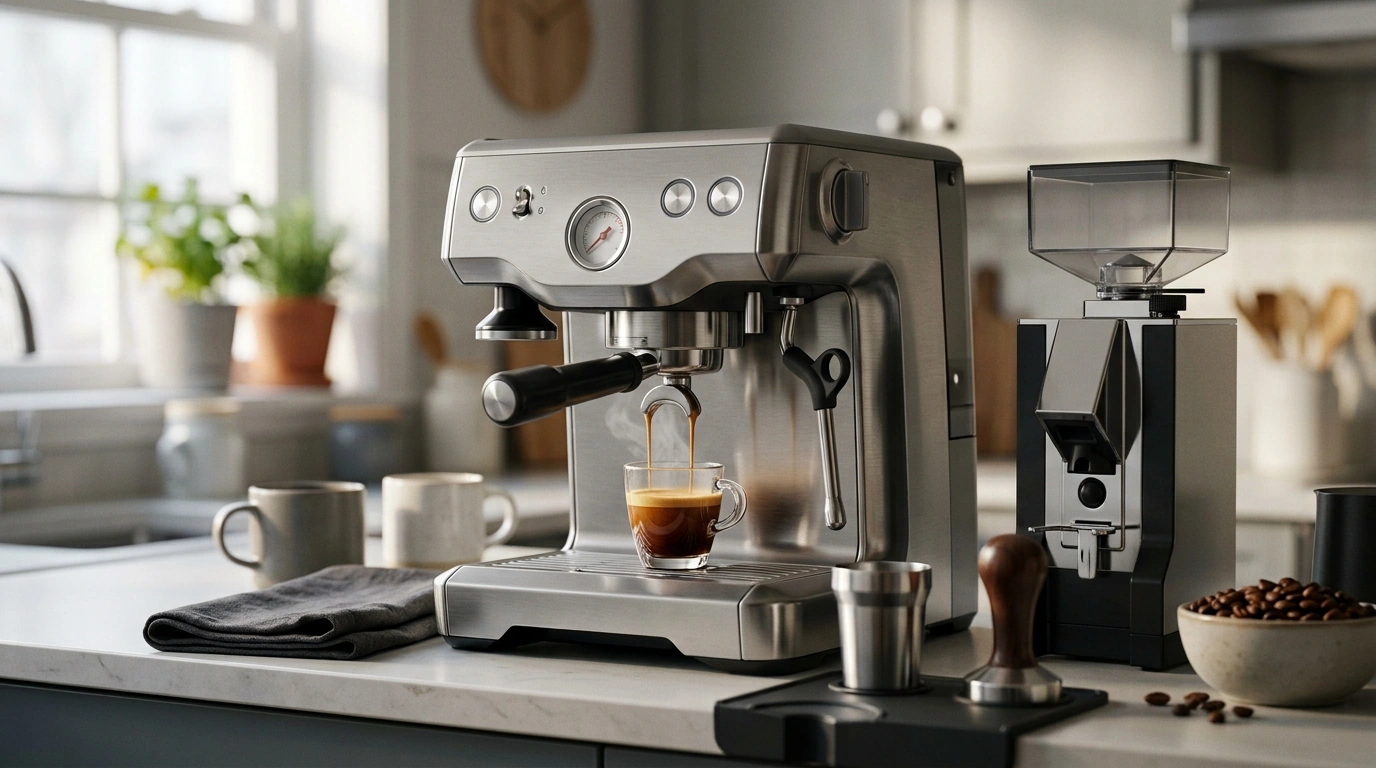
20 Bar Semi-Automatic Espresso Machine with Temperature Control and 58mm Portafilter
A semi-automatic espresso setup balances hands-on control with everyday convenience. With a 20 bar pump, adjustable temperature control, and a 58mm portafilter size commonly used in prosumer gear, this machine is built for consistent espresso, better shot repeatability, and a workflow that can grow as grind quality and puck prep improve.
What Sets This Machine Apart
This espresso machine focuses on the core variables that shape flavor: pressure, temperature, and a portafilter format that supports café-style accessories. Instead of locking you into one-button automation, it keeps the parts of the process that matter—dose, grind, distribution, and shot time—in your control.
- 20 bar pump pressure: designed to support espresso extraction with crema and body when grind and dose are dialed in.
- Temperature control: helps stabilize flavor and reduces sour/bitter swings between shots.
- 58mm portafilter: a widely supported size for baskets and tools, with a puck shape that can extract more evenly when prep is consistent.
- Semi-automatic workflow: control dose, grind, and timing without moving to a fully manual lever routine.
For shoppers comparing options, the easiest “baseline upgrade” is moving into the 58mm ecosystem while keeping temperature adjustable—two details that make it simpler to refine taste as skills improve.
Why Temperature Control Matters for Espresso
Brew temperature influences how quickly flavors dissolve out of coffee. Small shifts can change the balance between sweetness, acidity, and bitterness—especially when you’re pulling multiple shots in a row or testing a new bag of beans.
- Hotter water generally increases extraction and can push bitterness if the shot is already running long.
- Cooler water can highlight acidity and may under-extract lighter roasts (thin body, sourness) if the grind isn’t adjusted.
- Consistency improves when temperature is stable across back-to-back drinks, which is essential for dialing in.
- Grinder still matters most: temperature fine-tunes flavor, but grind size typically creates the biggest taste change.
For deeper brewing guidance and standards, the Specialty Coffee Association (SCA) brewing resources are a reliable reference. For practical storage and freshness basics that directly affect crema and clarity, the National Coffee Association (NCA) is also helpful.
58mm Portafilter: Practical Benefits and Accessory Compatibility
One of the most user-friendly features here is the 58mm format. It’s common enough that upgrades are easy to find, and it supports a workflow that matches café routines: weigh the dose in grams, measure yield in grams, and keep notes on time and temperature.
- Accessory availability: more options for precision baskets, tampers, distribution tools, and bottomless portafilters.
- Even puck geometry: a wider basket can promote more uniform flow when the coffee bed is level and properly tamped.
- Easy upgrade path: start with included tools, then improve one piece at a time once your technique is consistent.
- Skill transfer: routines you learn on 58mm translate cleanly to many café-style machines.
58mm Accessory Checklist
| Accessory | Why It Helps | When to Add It |
|---|---|---|
| 58mm calibrated tamper | More repeatable tamp pressure and a level puck | After basic dialing-in feels inconsistent |
| Precision basket (58mm) | Improves flow and can reduce channeling | After grinder and puck prep are stable |
| Bottomless portafilter (58mm) | Visual feedback for channeling and distribution | For troubleshooting shot quality |
| WDT tool | Breaks up clumps and improves distribution | If shots spray or taste uneven |
Dialing In: A Repeatable Starting Recipe
Espresso rewards consistency. Start with a simple baseline and change one variable at a time. A scale is the fastest way to make your results repeatable.
- Use fresh coffee and a consistent grind; espresso is sensitive to small grind changes.
- Start with a 1:2 ratio (example: 18 g in, 36 g out), then adjust for taste.
- Aim for a reasonable shot time window (often ~25–35 seconds), but let flavor be the final judge.
- Adjust in order: grind first, then dose, then temperature, then yield.
- Taste cues: sour/thin suggests under-extraction; bitter/dry suggests over-extraction.
Quick Troubleshooting Guide
| Problem | Likely Cause | Fast Fix |
|---|---|---|
| Sour, sharp shot | Under-extraction | Grind finer; slightly increase temperature; extend yield |
| Bitter, harsh shot | Over-extraction | Grind coarser; slightly reduce temperature; shorten yield |
| Watery body | Too coarse / too low dose | Grind finer; increase dose; improve tamp consistency |
| Spraying from portafilter | Channeling / poor distribution | WDT, level bed, tamp evenly; check basket fit |
Milk Drinks and Steaming Workflow
Everyday Use: Setup, Warm-Up, and Shot-to-Shot Consistency
Cleaning and Maintenance for Long-Term Performance
Maintenance Rhythm
| Task | Frequency | What It Prevents |
|---|---|---|
| Group flush and basket rinse | Daily | Old coffee oils and rancid flavors |
| Steam wand purge/wipe | Every milk drink | Clogs, odor, and poor steam performance |
| Deep clean removable parts | Weekly | Stains, buildup, uneven extraction |
| Descale (as needed) | Varies by water hardness | Flow issues, heating inefficiency, scale damage |
Who This Machine Fits Best
In-Stock Picks
- 20 Bar Semi-Automatic Espresso Machine with Temperature Control – 58mm Portafilter
- Calvin Klein Women’s Spring/Summer Backpack
FAQ
Is 20 bar too much pressure for espresso?
No—20 bar is typically the pump’s maximum capability, not the pressure that’s always applied at the coffee puck. Actual brew pressure depends on resistance from the grind, dose, and puck prep, so balanced taste and consistent flow matter more than the headline bar rating.
What does a 58mm portafilter change compared to smaller sizes?
A 58mm portafilter opens up broader compatibility with baskets, tampers, and distribution tools, and it supports a puck shape that can extract more evenly when prep is consistent. The size itself doesn’t magically improve flavor; the real benefit is consistency and access to precision accessories.
How should brew temperature be adjusted for light vs dark roasts?
Light roasts often benefit from slightly higher brew temperatures (and usually a finer grind) to improve extraction and sweetness. Dark roasts commonly taste better at slightly lower temperatures to reduce bitterness—make small changes and judge by flavor in the cup.
Recommended for you
Was this article helpful?
Yes
No







Leave a comment